Why Less Time in the Saddle Makes Better Riders
Why Less Time in the Saddle Makes Better Riders: The surprising science behind shorter mounted lessons — and the groundwork hour that changes everything.
Short answer: yes, absolutely. Pairing a focused 30-minute mounted lesson with a 60-minute unmounted horsemanship and groundwork session is a more effective and efficient way to teach beginner riders than spending that same time exclusively on horseback. Here's exactly why — and why the best riding schools in the Rio Grande Valley are built around this model.
The problem with "more saddle time" for beginners
It sounds logical: the more time you spend on a horse, the faster you'll learn to ride. But equestrian education research — and the experience of thousands of riding instructors — tells a different story. For beginners, extended mounted time often leads to fatigue, sensory overload, and reinforced bad habits.
After about 25–35 minutes in the saddle, a new rider's ability to absorb instruction drops sharply. The body is still physically engaged, but the mind disengages from deliberate learning and shifts into mere survival mode — holding on, balancing reactively, and reverting to tension. That tension, repeated session after session, becomes the default.
The result? Riders who spend years "unlearning" the stiffness and fear they built up in their very first lessons.
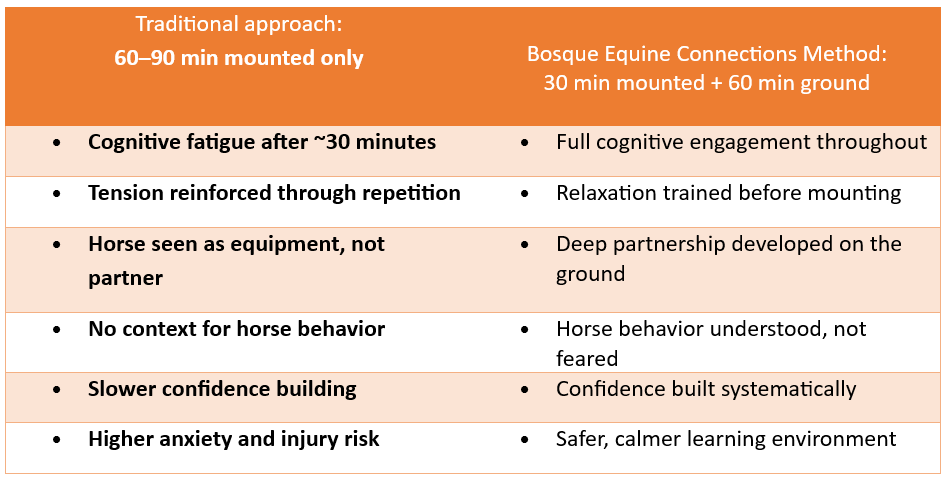
What happens in the 60-minute unmounted lesson?
This is the hour that separates competent riders from confident horsewomen and horsemen. The unmounted session isn't a lecture or a waiting room — it's where the most fundamental skills are built.
· Reading horse body language. Students learn to recognize what a horse is communicating before they ever ask it to move — ear position, eye softness, weight shifts, tension signals.
· Leading and yielding exercises. Groundwork teaches pressure and release — the very same language used in the saddle — in a low-risk, on-the-ground environment.
· Barn safety and horse care. Grooming, tacking, and safe movement around horses builds awareness that prevents the most common beginner accidents.
· Building trust and rapport. Horses respond to calm, intentional energy. Students who spend time earning a horse's respect on the ground mount with a fundamentally different relationship.
· In-hand work. Watching a horse move from the ground builds the eye and the instincts that translate directly to better feel in the saddle.
· Mindset and emotional regulation. Working with prey animals requires calm, patience, and self-awareness. Students develop these skills on the ground, where the stakes feel lower.
The horse doesn’t know you’re a beginner. It only knows whether you’re calm or anxious, clear or confusing, present or distracted. Groundwork is where you learn to be the kind of human a horse wants to work with.
The neuroscience of learning — and why 30 minutes is optimal
Motor learning research consistently shows that focused practice in short, high-quality sessions produces better retention than long, fatigued sessions. When a beginner rider mounts fresh — not physically or mentally depleted — their nervous system is in an optimal state to encode new movement patterns.
Riding is a full-body skill that requires simultaneous coordination of balance, core engagement, leg position, hand softness, and mental focus. Each of these competes for cognitive bandwidth. Thirty-focused minutes allows a student to work with quality intention; sixty minutes often becomes an exercise in managing discomfort.
There's also the matter of the horse. A quality lesson horse giving its best during a 30-minute session is a more honest and responsive teacher than a tired horse tolerating another 30 minutes of an uncertain rider. Both student and horse stay in their best learning states.
How the progression works
Connection before control. Groundwork dominates. Students learn to catch, halter, lead, and groom. Mounted time introduces basic position and walk only — no agenda except relaxation.
Communication foundations. Pressure-and-release concepts learned on the ground transfer directly to rein and leg aids in the saddle. Students begin to trot with meaningful intention.
Fluency and independence. Riders who built their foundation correctly begin developing genuine feel. The groundwork hour evolves into more nuanced in-hand exercises.
Partnership and advancement. Students who followed this model typically advance twice as fast as those from conventional lesson programs — with notably fewer fear responses and resistances to address.
For riders in the greater Corrales area
If you're in the North Rio Grande Valley — whether you're in Corrales, Albuquerque's North Valley, Rio Rancho, Bernalillo, Placitas, or Los Ranchos de Albuquerque — you understand that the horse community here is different. This is a working agricultural region with a deep equestrian culture rooted in practicality and partnership.
That culture is exactly why the Bosque Equine Connections method resonates so strongly here. Along the bosque, people have long understood that a horse you can work with on the ground is a horse you can trust anywhere. The cottonwood-lined trails, the generations of horsemanship passed down through New Mexican families — all of it points toward the same truth: groundwork is not a detour. It is the path.
Whether your child is seven years old and horse-crazy, or you're an adult returning to riding after decades away, this is the most direct route to becoming a capable, confident, and compassionate rider in our landscape.
Begin your journey with us
Book your 45-minute introductory lesson today with us. You’ll get a taste of both sides.